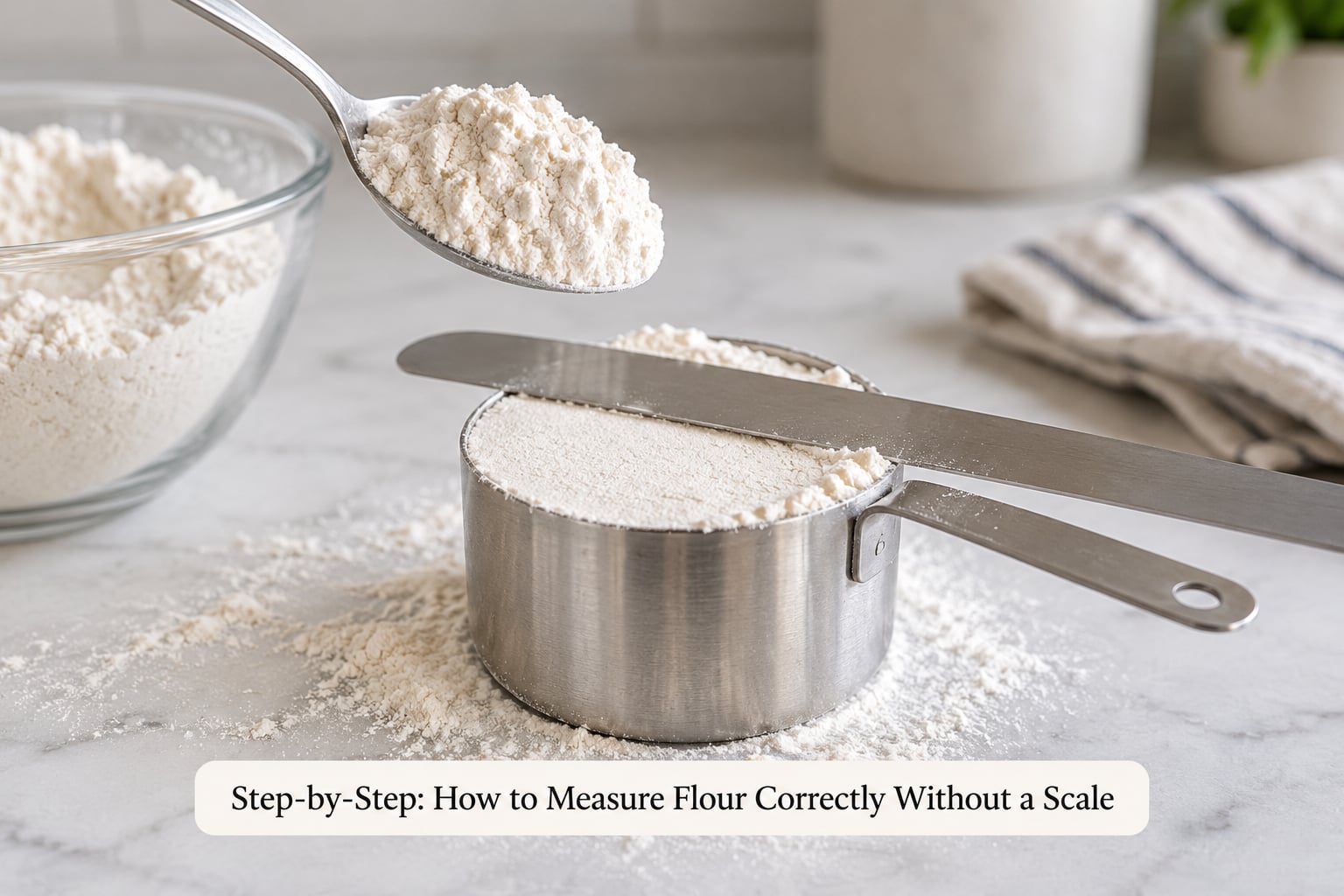
Measuring flour correctly without a scale comes down to one habit: fluff the flour, spoon it loosely into a dry measuring cup until it mounds over the rim, then level the top with the straight edge of a knife or spatula. Do that the same way every time and your volume measurement becomes repeatable, which is the whole ballgame when a recipe says “1 cup” and you own no scale.
The three steps, in order:
- Fluff the flour in its container with a spoon or your hand first, so compacted lumps break apart.
- Spoon flour into a dry 1-cup measure until it mounds above the rim. Never dip the cup straight into the bag.
- Level the top with the flat back of a knife or a straight-edged spatula, sweeping the excess back into the bag.
It takes about fifteen seconds per cup and it fixes the single most common home-baking failure: too much flour. Here is the full method, the numbers behind it, and what to do when the recipe is written in grams.
Updated for October 2026.
Table of Contents
- What You Need
- Step-by-Step: How to Measure Flour Correctly Without a Scale
- Step 1: Choose the Right Measuring Cup
- Step 2: Decide Between Spooning and Packing
- Step 3: Fill and Level the Cup Without Air Pockets
- Step 4: Measure Flour Without a Scale for Small or Precise Amounts
- Step 5: Check the Batter or Dough
- Common Mistakes
- Scooping the cup straight into the bag
- Heaping the cup instead of leveling it
- Using a liquid measuring cup for flour
- Measuring over the mixing bowl
- Skipping the fluff
- Ignoring the recipe’s stated method
- Using an off-size spoon
- Using flour scoops for standard recipes
- Assuming one weight for every flour
- Frequently Asked Questions
- How do I measure 1 cup of flour without a scale?
- How can I weigh 100g of flour without a scale?
- Is 1 cup of sifted flour the same as 1 cup of flour?
- How much do 2 cups of flour weigh?
- Is a US cup the same as an Australian cup?
- What can I use instead of a scale for measuring flour?
- Conclusion
What You Need
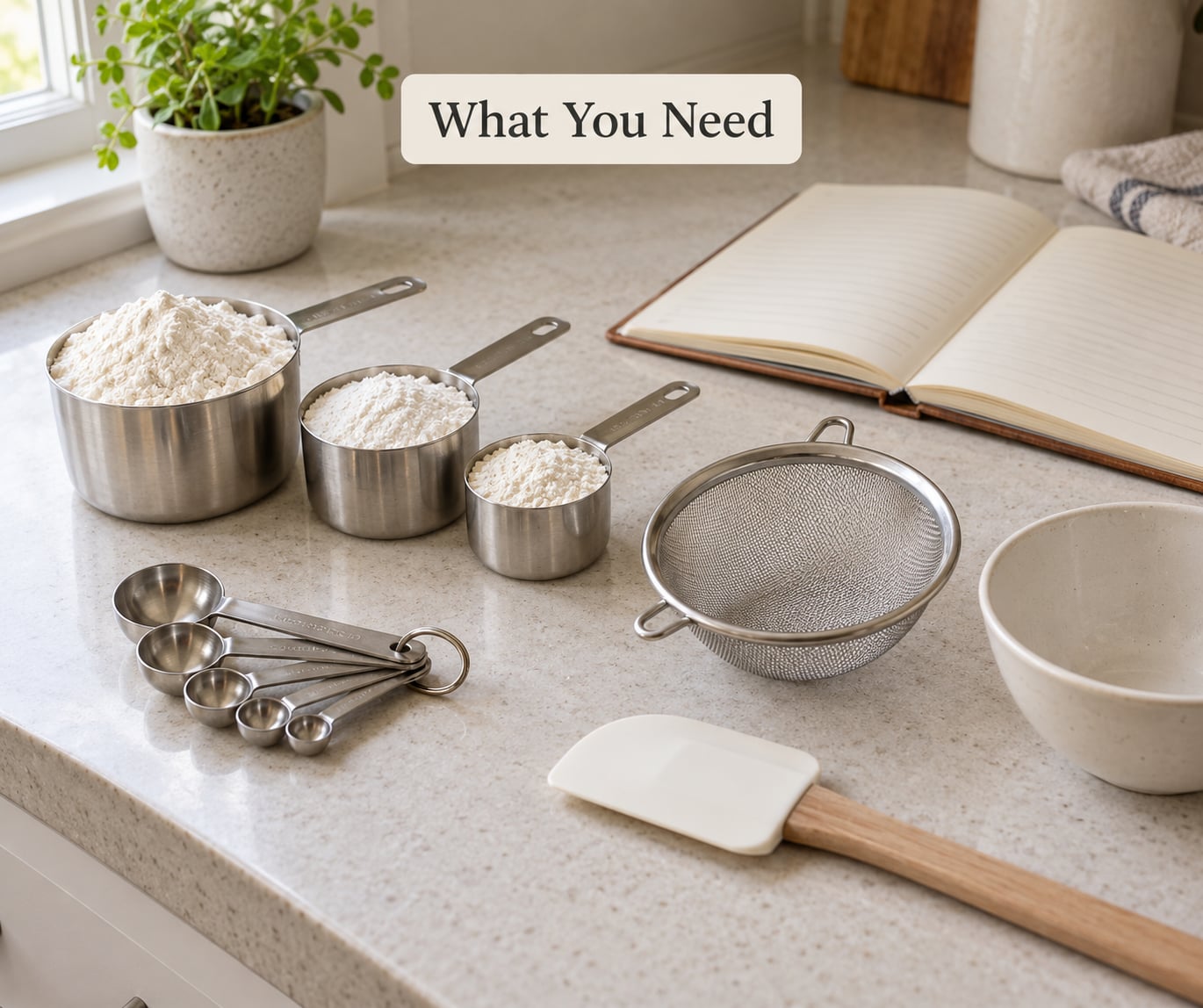
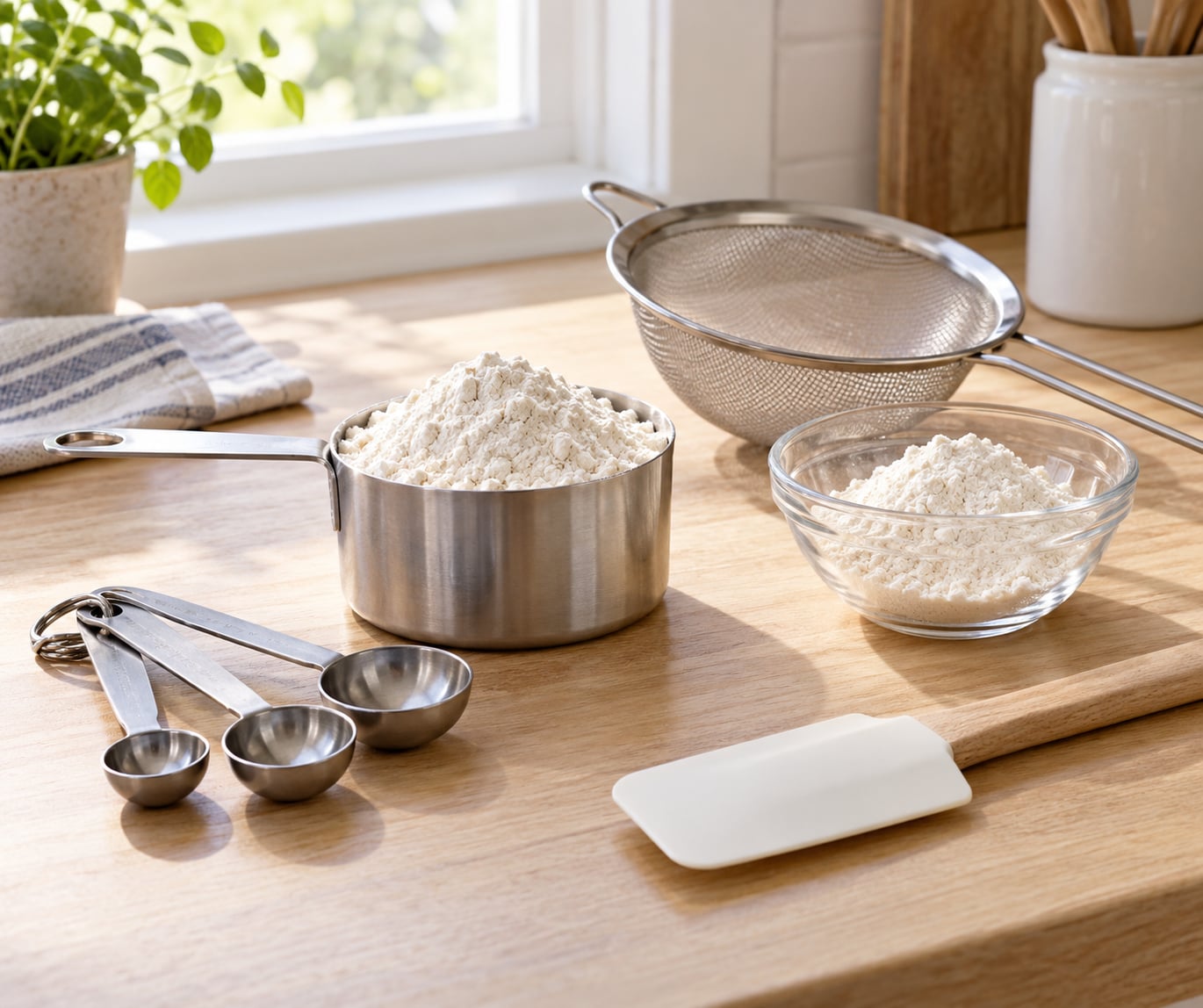
A dry measuring cup is the one tool that matters. Everything else is a substitute for the scale you do not have.
- Dry measuring cups, ideally a full set so you can level a quarter cup without doing gymnastics with a one-cup measure.
- A leveler — the back of a butter knife, a straight-edged spatula, or the metal ramp on some measuring spoon sets.
- Standard dry measuring spoons for teaspoons and tablespoons. Level them the same way you level the cups.
- A wide bowl so you can fluff the flour without scattering it over the counter.
- A sieve if the recipe calls for sifting. Optional, but worth having for cake flour and gluten-free blends.
- The flour bag itself. Turn it over and read the serving size on the nutrition panel. Most bags in the US list a quarter cup as a 30g serving, which quietly tells you what one of your cups should weigh.
Skip the liquid measuring cup. Its rim is narrower, the handle is longer, and the printed fill lines are calibrated for water. Flour is a loose powder that settles below a liquid line, so a cup of flour measured in a glass jug looks short and disappoints you by a good margin.
Also skip flour scoops if you have a proper measuring cup. Those little handled scoops are designed to hold roughly a quarter cup more than a level standard cup, which is a quiet way to wreck a biscuit recipe that has no margin for error.
Step-by-Step: How to Measure Flour Correctly Without a Scale
Why does a quarter cup of flour error matter so much? Because flour is the only dry ingredient most cakes, cookies and breads are built around, and it is the one people measure worst. Cup volume is a proxy for weight, and proxies only work when the density stays constant. Every time you pack flour down, you change that density and the proxy breaks.
The gap is not subtle. A spooned, leveled cup of all-purpose flour runs about 120 to 125g. A scooped, packed cup can hold around 150g. That is roughly a quarter cup more dry ingredient than the recipe asked for, and you will taste it: cookies turn dry and crumbly, brownies go tough and cakelike, cakes come out dense and heavy with a rough crumb, pie crusts crack before they roll, and biscuits and scones bake up dense instead of tall and flaky.
Step 1: Choose the Right Measuring Cup
A standard dry 1-cup measure has a wide rim and a short handle, and it is built to be filled past the rim and leveled. That is the shape the recipe was written around, so it is the shape you want.
A one-cup dry measure also gives you the quarter and third cups you need by estimating with the leveler. Fill it and level, then take a quarter of that volume off by tipping the cup until the flour is divided cleanly. For recipes calling for a third of a cup, fill the cup and level, then level off one third of the way down. Sloppy, but consistent, which is what matters.
Liquid measuring cups do the opposite. They are narrow to prevent sloshing and marked for volume of liquid. A cup of flour scooped into a liquid measure sits well below the 1-cup line, and the small amount that would sit above it is the whole reason people under-measure with glass jugs and then wonder why their cake is wet in the middle.
Step 2: Decide Between Spooning and Packing
Two methods exist, and conflicting advice about which is correct is the loudest argument in baking forums. On r/Baking the split is almost perfectly down the middle: one camp measures by weight and nothing else, the other measures by volume and insists on spooning rather than scooping. The honest answer is that the recipe decides, and you follow whatever the recipe says.
Spoon and level is the default for almost every American recipe. Scoop and level shows up in a handful of sources, and it is never a casual instruction. When a recipe explicitly asks you to pack the cup or to spoon flour in, that is not a throwaway phrase.
CakeCentral’s old forum thread on measuring flour is where a lot of people land with this question, and the consensus there is worth remembering: follow the wording of the recipe you are actually baking. When two sources disagree, the one in front of you wins.
Whichever method you pick, use it consistently. A baker on r/Cooking put it plainly: measuring by volume is only accurate if the volume is always measured the same way. Switching between packed and spooned halfway through a recipe is worse than being a little off every single time.
Step 3: Fill and Level the Cup Without Air Pockets
Put your bowl next to the flour, not underneath the cup. Measuring over the bowl seems tidier, and it costs you. Every time you dip the cup into the bag and pull it out, the flour compacts, air pockets settle, and you pack more dry ingredient into the same cup.
Fluff the flour in the bag with a spoon or a clean hand so any compacted areas break up. Then scoop flour out with a spoon and drop it into the cup. Keep going until the flour mounds above the rim, then level.
To level, rest the straight edge of your knife or spatula on the rim and sweep across in one motion. A back-and-forth sawing motion drags flour around and can leave the surface slightly concave. One firm pass leaves a flat top, and a flat top is the entire goal. Tip the excess back into the bag and move to the next cup.
If the recipe says “1 cup flour, sifted”, measure and level first, then sift. If it says “1 cup sifted flour”, sift first, then measure and level. Those two wordings are not interchangeable and can differ by around 12 percent, which is enough to flatten a cake or tighten a pie crust.
Sifting after measuring also inflates the flour, so the cup you just filled may look under-full after sifting. That is correct. Sift it back over the bowl or the pan and let it land loosely.
Step 4: Measure Flour Without a Scale for Small or Precise Amounts
Tablespoons are where precision gets hard, because one level tablespoon of all-purpose flour weighs only about 8g. Work from that number and the grams stop being a mystery.
That means roughly 12 to 13 level tablespoons of AP flour make 100g, and about 25 make 200g. If a recipe calls for 150g, that is 18 to 19 level tablespoons, which in practice is easier to do as one leveled cup plus 3 tablespoons.
Mugs work too, with one caveat. A standard 250ml mug holds about the same volume as a 1-cup measure, so a mug of spooned and leveled all-purpose flour lands near 125g. Check yours once by pouring water from the mug into your measuring cup. If the mug is full at the 1-cup line, treat it as a cup.
Here is the cups-to-grams conversion for common flours. These are spooned and leveled weights, which is the method nearly all recipes assume.
| Flour | 1 cup | 1/2 cup | 1/3 cup | 100g in cups | 200g in cups |
|---|---|---|---|---|---|
| All-purpose / plain | about 125g | about 62g | about 42g | just under 1 cup | 1 cup plus 3 Tbsp |
| Bread flour | about 127g | about 63g | about 42g | just under 1 cup | 1 cup plus 3 Tbsp |
| Cake flour, sifted | about 115g | about 57g | about 38g | about 1 cup | 1 and 3/4 cups |
| Whole wheat | about 120g | about 60g | about 40g | about 1 cup | 1 and 2/3 cups |
| Self-rising | about 125g | about 62g | about 42g | just under 1 cup | 1 cup plus 3 Tbsp |
| Gluten-free blend | about 120g | about 60g | about 40g | about 1 cup | 1 and 2/3 cups |
Two cups of spooned, leveled all-purpose flour, then, is about 250g, or roughly 8.8 ounces.
If your recipe is in grams and you want cups, run it backwards through the same table. For a 350g bread recipe using all-purpose flour, that is about 2 and 3/4 cups.
Check the bag before you trust any chart, including this one. If the nutrition panel says one quarter cup equals 30g, then one of your cups equals 120g, and that bag wins over every table online.
Step 5: Check the Batter or Dough
A finished mix tells you whether the flour amount was reasonable, and you can read it before the oven does.
Cake batter should be smooth and pourable, with no streaks of dry flour after about a minute of mixing. If it sits in thick ropes and drags the spoon, you are heavy on flour. If it runs off the spoon like milk, you are light.
Cookie dough should feel soft but not tacky, and pressing a finger into the ball should leave an impression that springs back partway. Bread dough should feel tacky and slightly elastic, and a small piece stretched thin should not tear immediately. A dough that tears straight off with no stretch has too much flour and no gluten development left to work with.
One honest limit: spoons and cups are not as accurate as a scale. Bakers on r/Breadit who went a week without weighing reported flatter, denser loaves, and the pattern is predictable. Volume measuring works best for forgiving recipes — cookies, muffins, quick breads, cornbread — and works poorly for high-rising yeast work and delicate pastry, where a 20 percent swing is the difference between a good biscuit and a hockey puck.
Common Mistakes
Scooping the cup straight into the bag
This is the mistake behind most of the others. The cup fills, the flour compresses on the way out, and you are holding about 150g where the recipe wanted 125g. Fix: spoon the flour out and level it. Every time, including the second and third cups of the same recipe.
Heaping the cup instead of leveling it
A heaped cup can carry 30 to 40 percent more than a level one. If a recipe wanted a heaped cup it will say so. Fix: sweep the top flat with a straight edge, then use the surplus for something else.
Using a liquid measuring cup for flour
The narrow rim and the liquid fill lines make the fill inconsistent, and flour settles below the line so you usually end up short. Fix: one dry measure for flour, one liquid measure for milk and water.
Measuring over the mixing bowl
It feels efficient and it is not. The cup touching the bowl packs the flour as you fill it. Fix: fill beside the bowl, level, then dump.
Skipping the fluff
Flour that has sat in a warm pantry or a humid summer kitchen forms lumps and a settled layer. Spooning into a cup without fluffing gives you fewer air spaces than the recipe assumed. Fix: fluff the whole container, then work from the top.
Ignoring the recipe’s stated method
“Spooned”, “packed”, “heaped”, “sifted” and “1 cup flour, sifted” are all instructions, not decoration. Fix: if the wording is unusual, assume it matters.
Using an off-size spoon
A soup spoon, a teaspoon with a thick handle, or a 15ml metric tablespoon all give different volumes than a standard US 15ml tablespoon. Fix: standard measuring spoons, leveled the same way as your cups.
Using flour scoops for standard recipes
A typical flour scoop holds about 1 and 1/4 cups. That extra quarter cup is enough to sink a cake. Fix: use scoops only for recipes written for scoops.
Assuming one weight for every flour
Whole wheat and most gluten-free blends sit slightly lighter per cup than all-purpose, and cake flour sits lighter after sifting. Between brands, gluten-free blends vary enough that one brand’s cup can run noticeably lighter than another’s. Fix: check the bag panel, and treat cookies and cakes made with those blends as a calibration test rather than a reliable recipe.
Regional bakes have their own tolerances. Cornbread, biscuits, hand-rolled pie crust and dumplings lean on precise flour amounts more than a layered cake does, so they are the best place to put the bag-panel habit to work before you attempt something finicky.
Frequently Asked Questions
How do I measure 1 cup of flour without a scale?
Fluff the flour, spoon it loosely into a dry 1-cup measuring cup until it mounds above the rim, then level the top with the straight edge of a knife or spatula. Spooned and leveled all-purpose flour weighs about 125g, compared with roughly 150g for a cup scooped and packed. Do not dip the cup into the bag, and always use a dry measure rather than a liquid one.
How can I weigh 100g of flour without a scale?
Use a standard tablespoon. One level tablespoon of all-purpose flour is about 8g, so roughly 12 to 13 level tablespoons make 100g. For 200g, use about 25 level tablespoons, or one heaped-free 1-cup measure plus 3 tablespoons. Level every spoon with a straight edge, and check the bag’s nutrition panel first, since it often lists a quarter cup as a serving and gives you the true ratio for that flour.
Is 1 cup of sifted flour the same as 1 cup of flour?
No. Sifting aerates the flour, so a sifted cup weighs roughly 12 percent less than an unsifted one, about 110g instead of about 125g for all-purpose. The wording matters: 1 cup flour, sifted means measure and level first, then sift. 1 cup sifted flour means sift first, then measure and level. Reading those two the wrong way shifts the dry ingredient by enough to change the bake.
How much do 2 cups of flour weigh?
Two cups of spooned, leveled all-purpose flour weigh about 250g, or 8.8 ounces. Bread flour runs slightly heavier at about 254g, cake flour after sifting is lighter at about 230g, and whole wheat is about 240g. Gluten-free blends vary most between brands. Remember these figures assume leveling, not packing, which can add another 50g across two cups.
Is a US cup the same as an Australian cup?
No. A US legal cup is 240ml and an Australian kitchen cup is 250ml, and an Australian tablespoon is 20ml against the US 15ml. A metric tablespoon of flour therefore weighs about 10g rather than about 8g. If you are converting a UK or Australian recipe, expect a roughly 4 percent difference in cup volume, and use grams whenever the recipe gives them, since metric recipes assume metric cups.
What can I use instead of a scale for measuring flour?
A dry measuring cup with a leveler is the best substitute, and it is accurate enough for cookies, muffins, quick breads and cornbread. Beyond that: a level tablespoon for small and gram-target amounts, a 250ml mug checked against your 1-cup measure, and the flour bag’s own nutrition panel to calibrate your kitchen. A mug of leveled AP flour is about 125g. None of these beat a scale for yeast breads and pastry.
Conclusion
Start with the recipe’s stated method, a proper dry measuring cup, and a level top, and make that your default. A spooned, leveled cup of all-purpose flour is about 125g, and if you measure it the same way every single time, your baking gets predictable.
Only adjust the flour when the finished batter or dough clearly tells you something is off, and adjust by a tablespoon at a time. That is how to measure flour correctly without a scale, and it costs you nothing but the fifteen seconds it takes to be careful.