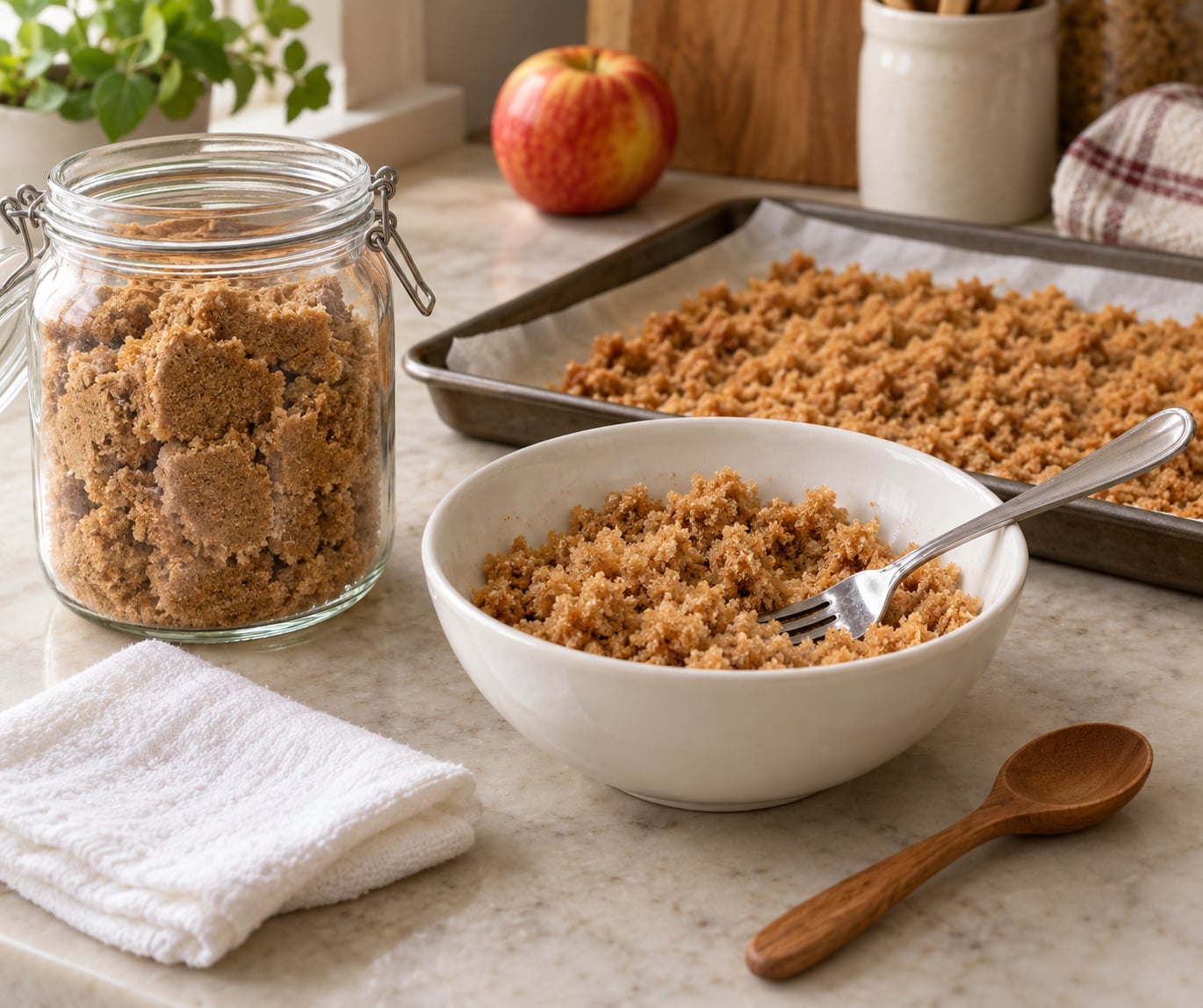
How to soften hardened brown sugar? Put the clumps in a microwave-safe bowl, cover with a damp paper towel, heat for 15 to 20 seconds, then fluff with a fork. It takes under a minute, it costs nothing, and hard sugar is not bad sugar.
That last point trips people up. Hardening is moisture loss, nothing more. Nobody in the history of baking threw away a bag of brown sugar because of a lump, but plenty of us quietly give up on a batch of cookies and buy a fresh box instead.
So yes, hardened brown sugar is safe to use. You are putting back water, not adding anything new, and once it is soft and scoopable again it behaves exactly like sugar that never hardened.
A solid block does cause real problems in the bowl, though. It cannot be measured, creamed with butter, or distributed evenly, so cookies come out lumpy and flat instead of chewy. That is worth ten minutes of your time.
Table of Contents
- What You Need to Soften Brown Sugar
- Step-by-Step: How to Soften Hardened Brown Sugar
- Microwave Method: The Fastest Fix for Small Clumps
- Oven Method: Gentler Heat for Bigger Quantities
- Stovetop Method: No Microwave Required
- Common Mistakes That Leave Brown Sugar Hard or Sticky
- Frequently Asked Questions
- Can you soften hardened brown sugar in the microwave?
- What is the best way to soften brown sugar for baking cookies?
- How much water should I add to hardened brown sugar?
- How long does it take to soften brown sugar on the stove?
- Why does brown sugar become hard again after I soften it?
- How should softened brown sugar be stored?
- Conclusion
What You Need to Soften Brown Sugar
For the microwave method you need a microwave-safe bowl, a damp paper towel or a loose-fitting lid, and a fork. The oven method needs a heat-safe dish with a tight lid, or a parchment-lined baking sheet, plus your oven. The stovetop method needs a small saucepan and a wooden spoon.
You also need water, and this is where most recipes get vague and most batches go wrong. The reliable figure is 3/4 teaspoon of water, roughly 3.5 grams, for every 8 ounces of hardened brown sugar. A kitchen scale makes that foolproof; measuring by eye is where gummy cookies come from.
For storing it afterward, keep an airtight container on hand. A glass jar with a rubber gasket, a plastic tub with snap latches, or the bag the sugar came in if you roll the top down tight will all hold moisture in.
Here is how the three methods compare before you pick one.
- Microwave. 15 to 20 seconds per cup. Needs a microwave-safe bowl, a damp towel, and a fork. Cup-sized batches only. It re-hardens as it cools, so use it right away.
- Oven. 5 to 10 minutes. Needs a heat-safe dish with a lid, or a baking sheet. Works on a large block spread in one layer. Softest result, so there is no time to wait.
- Stovetop. 3 to 5 minutes. Needs a small saucepan and a wooden spoon. Works on large blocks in batches. It is the easiest way to scorch the sugar.
- Water and knead. 30 minutes standing, or a 15-second zap. Needs a zip-top bag, a scale, and your hands. Works on the whole bag at once. Takes some elbow grease.
- Bread or apple slice. 8 to 24 hours. Needs only an airtight container. Works on anything. Needs advance planning and uses up food.
Step-by-Step: How to Soften Hardened Brown Sugar
Pick the method that matches how much time you have. The microwave is for when the dough is already mixed and you need sugar in the next sixty seconds. The oven is gentler and gives a more even result when you have ten minutes. The stovetop works when you have no microwave at all and a hard block in your hands.
Microwave Method: The Fastest Fix for Small Clumps
This is the one to reach for mid-bake, and the cue that it is working is steam at the edges of the bowl the moment you lift the towel.
- Break up the hardened sugar with the back of a spoon or the side of a heavy knife so you have chunks, not one sealed brick.
- Put the sugar in a microwave-safe bowl deep enough that nothing sits above the rim.
- Dampen a paper towel with water and wring it out until it is damp, not dripping. Lay it over the top of the bowl.
- Heat on high for 15 to 20 seconds for roughly one cup of sugar.
- Lift the towel carefully, away from your face, and stir the sugar with a fork. Every hard piece you can feel is one more 10-second burst.
- Stop as soon as the sugar is soft and crumbly. Melted sugar is a different problem, and once it pours it will not come back.
Spread the softened sugar on a baking sheet to cool faster if you are in a hurry, then move it into an airtight container while it is still slightly warm. Warm sugar sealed up keeps its texture for days.
Oven Method: Gentler Heat for Bigger Quantities
Low-and-slow oven heat rehydrates a whole tray without the scorching risk that makes people nervous about microwaved sugar.
- Heat your oven to 250F and let it come to temperature while you prepare the sugar.
- Spread the hardened sugar in a single even layer on a parchment-lined baking sheet, or put it in an oven-safe dish with a tight lid on top.
- Warm it for 5 to 10 minutes, stirring or turning once halfway through if you are using the sheet.
- Test it by pressing a fingertip into a clump. If it gives and breaks apart instead of resisting, it is done.
- Pull it out the moment it softens. Oven-softened brown sugar has almost no water left in it, so it will harden again in a few hours if you wait.
The covered dish holds more of the original moisture than the open sheet does. If you are going straight into a cookie recipe, the sheet version gives you more usable sugar because it rehydrates a larger surface.
Stovetop Method: No Microwave Required
A small saucepan is the most reliable option when you are softening a five-pound block that has fused into one piece, because you can control the heat one lump at a time.
- Set a heavy saucepan over medium-low heat and add 1 to 2 teaspoons of water for each cup of sugar.
- Add the sugar and let it sit undisturbed for about a minute so the water can wick into the crystals.
- Start breaking it up with the back of a wooden spoon, pressing the block against the side of the pan and stirring slowly.
- Keep the spoon moving the whole time. Sugar scorches at the edge of a dry pan before the middle of the batch has softened.
- As soon as the clumps break apart and the mixture looks like damp sand, take the pan off the heat.
Pour it straight onto a cool plate or into a cold bowl. Residual heat keeps cooking it, and sugar left sitting in a hot saucepan will turn to caramel in a hurry.
Common Mistakes That Leave Brown Sugar Hard or Sticky
The most common mistake is adding too much water. A splash that feels right at the bowl can turn cookies gummy, because you are measuring by eye against a ratio that is closer to 3.5 grams per cup than most recipes admit.
The second mistake is heating too long. Sugar melts somewhere around 320F, and once it melts you have syrup, not softened sugar. Pull it at the first sign of softening and let residual heat finish the job.
Skipping the fluff is the third. Warming softens the surface and leaves hard cores buried inside. Fork through the whole bowl, break the cores apart, and then fluff once more.
The fourth is leaving it open. Microwaved and oven-softened sugar both need to go into a sealed container while they are still warm. Set it on the counter to cool and you will find it hard again within hours.
The fifth is forgetting what you put in. That slice of bread or apple still sitting in the jar becomes a mold vector in a humid kitchen. Set a reminder, and pull it out as soon as the sugar is soft.
One more thing worth knowing: some sugar is not merely dry, it is old or overheated from processing. If the hardened sugar smells of burnt caramel rather than molasses, or your cookies taste bitter and flat even after the texture is fixed, softening will not rescue it. A grey tint and dark specks are usually just concentrated molasses, which is normal, but any fuzzy growth means the sugar goes in the bin.
Frequently Asked Questions
Can you soften hardened brown sugar in the microwave?
Yes, and it is the quickest fix. Put the sugar in a microwave-safe bowl, cover it with a damp paper towel, heat on high for 15 to 20 seconds, then fluff with a fork. Add 10-second bursts until every clump is soft. Use it right away, because microwave-softened sugar hardens again as it cools.
What is the best way to soften brown sugar for baking cookies?
For cookies, softness matters most because creaming brown sugar with butter is what makes them chewy. Warm the amount you need, fluff it well, and get it into the bowl before it cools again. If you softened a whole bag earlier, reheat it in 10-second bursts rather than assuming it is still soft.
How much water should I add to hardened brown sugar?
Use 3/4 teaspoon of water, about 3.5 grams, for every 8 ounces of hardened brown sugar. Weigh it if you can. That is enough to rehydrate the sugar without making your cookies gummy. Add water a little at a time and knead or stir until the texture is even and slightly damp.
How long does it take to soften brown sugar on the stove?
Usually 3 to 5 minutes over medium-low heat, working in batches of about a cup at a time. Add 1 to 2 teaspoons of water per cup, break the clumps with a wooden spoon, and keep stirring. As soon as the texture looks like damp sand, take the pan off the heat and let it cool out of the pan.
Why does brown sugar become hard again after I soften it?
Because brown sugar is hygroscopic, which means it pulls moisture from the air and slowly loses it. Sugar that has been heated has very little moisture left to hold, so it re-hardens faster than the original. Store it in an airtight container while it is still warm and it will stay soft for weeks.
How should softened brown sugar be stored?
Transfer it to an airtight container while it is still warm, then let it cool with the lid on. Glass jars with rubber gaskets work well, and the original bag works if you roll the top down tightly. If you want a passive option, a soaked terracotta disk in the jar releases moisture into the sugar over a day or two.
Conclusion
Start with the microwave: a damp paper towel, 15 to 20 seconds, and a fork. That is the whole answer for a cup of clumped sugar, and it costs nothing. For a block the size of a brick, the stovetop in batches gives you more control than any oven method.
Before the sugar goes in the bowl, press a fingertip into it. It should give and crumble, not smear or pour. Then seal it into an airtight container while it is warm, and the next batch of cookies will be waiting on a soft, scoopable supply.